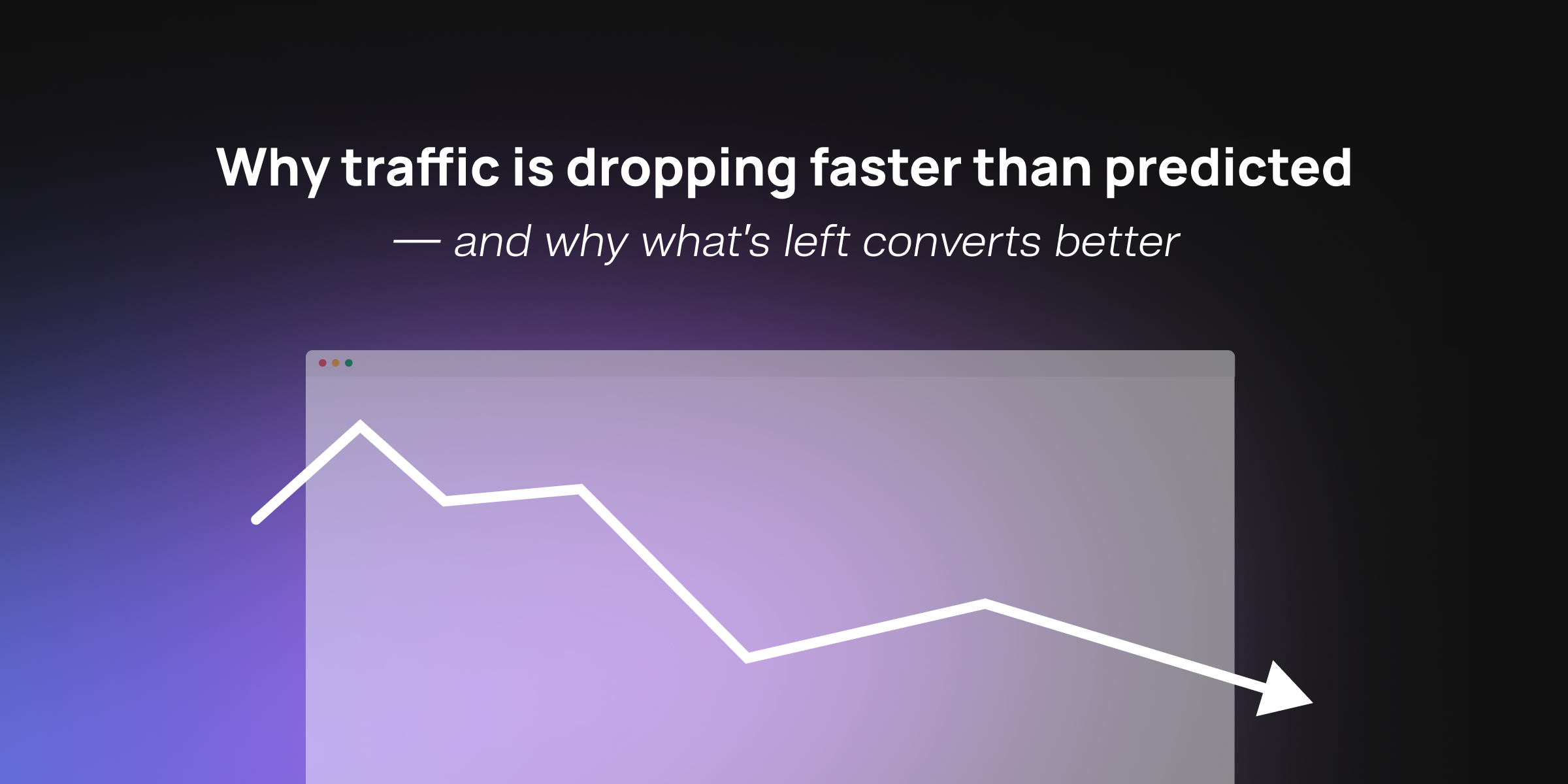

If your traffic numbers look different than they used to — fewer visits to informational pages, flatter growth even while rankings hold steady — that's not a sign something broke. It's a structural shift in how people search. AI-generated answers (Google's AI Overviews, ChatGPT, Perplexity, and similar tools) are now resolving a large share of searches before a click ever happens. This guide covers what's actually happening to traditional search traffic, why it's moving faster than most 2024-era forecasts expected, and the less-reported half of the story: the traffic that does reach your site through AI platforms tends to convert noticeably better than traditional organic visitors.
A few data points explain most of what you're seeing in your analytics:
Metric | 2026 Data |
Organic CTR with an AI Overview present | ~0.6%, down from ~1.8% without one (roughly a 61% drop) |
Position #1 CTR when an AI Overview appears above it | down roughly 35% |
Zero-click searches (all queries, global average) | roughly 60% |
Zero-click rate specifically for AI Overview / AI Mode queries | 80–93% |
Share of Google queries showing an AI Overview | roughly 13% in late 2025, climbing toward and above 45% by mid-2026 (estimates vary by source and query type) |
Top-10 ranking → cited in AI Overview (overlap rate) | ~75% in mid-2025 → 17–38% in early 2026 |
Projected organic traffic decline (Gartner forecast) | ~25% by 2026, 50%+ by 2028 |
Figures are aggregated from multiple 2025–2026 industry studies (Ahrefs, Seer Interactive, Search Engine Land/Graphite, Gartner, and others). Methodologies differ, so treat exact percentages as directional rather than universal.
Why It's Moving Faster Than Expected
Most 2024 forecasts (including Gartner's original prediction) framed this as a gradual, multi-year shift. Three things accelerated the timeline:
- AI Overview coverage roughly tripled in the space of a year, rather than growing steadily — and it's now concentrated on exactly the commercial and comparison searches that used to drive the most qualified traffic, not just simple factual queries.
- Ranking well no longer guarantees AI visibility. The overlap between a top-10 organic ranking and being cited inside an AI Overview has collapsed from roughly three-quarters of citations down to well under half — meaning traditional SEO and “getting cited by AI” are increasingly two different jobs, not one.
- The decline isn't even across all content. Simple, factual, how-to and FAQ-style pages are losing the most clicks, because AI answers can resolve those questions completely. Comparison, pricing, and decision-stage pages are holding up meaningfully better.
The practical effect: a page that ranked #1 and drove strong traffic in 2023 can produce a fraction of the sessions today at the same ranking, with no penalty or content quality issue involved — the click is simply being absorbed by the answer box above it.
The Other Half of the Story: AI Traffic Converts Better
While overall visit volume from AI platforms is still small — typically around 1% or less of total site traffic today — multiple independent studies agree on one thing: the visitors who do click through from an AI answer convert at meaningfully higher rates than traditional organic visitors. Reported multipliers range widely by study and industry, from roughly 4x up to more than 20x.
One frequently cited platform-level breakdown, from a Seer Interactive case study, illustrates the pattern:
Source | Measured Conversion Rate | vs. Google Organic |
ChatGPT | ~15.9% | ~9x |
Perplexity | ~10.5% | ~6x |
Claude | ~5.0% | ~3x |
Gemini | ~3.0% | ~2x |
Google Organic (same study) | ~1.76% | baseline |
This is one case study on one client's data, not a universal rate. Broader industry averages are more modest — First Page Sage's cross-industry analysis found ChatGPT-referred conversion rates ranging from roughly 1.4% to 7% depending on the industry. Use the direction of the pattern, not the exact multiplier, when setting expectations.
Why AI-Referred Traffic Converts Better
The mechanism is consistent across studies, even where the exact numbers differ:
- Pre-qualification: AI answers filter out casual, early-stage “just curious” searchers before they ever reach your site — the people who do click through usually had a specific enough question that the AI pointed them onward
- Visitors arrive already informed: they've typically already gotten the basic explanation from the AI answer and are clicking through to compare, verify, or take the next step, not to learn what property management is from scratch
- Some platforms show deeper engagement per visit — ChatGPT-referred visitors, for example, have been observed browsing more pages per session than average organic visitors, consistent with someone actively comparing options
What This Means for Property Management Marketing
- Don't panic if session counts on generic informational pages (“what does a property manager do,” basic FAQ content) trend downward — that traffic loss is largely the AI Overview effect, not a sign the page or ranking failed
- Pricing pages, service-specific pages, and city/market landing pages — the decision-stage content prospective owners use to compare providers — are the pages most likely to hold their traffic and lead volume
- Being citation-worthy is now a separate goal from ranking well. Clear, direct factual statements, well-structured headings, and structured data (schema markup) improve the odds of being the source an AI answer cites or points a searcher toward
- Track AI referral traffic separately where possible — GA4 doesn't bucket ChatGPT, Perplexity, or Gemini visits into their own channel by default, so they often get miscounted as “Direct” or generic “Referral” traffic unless a custom channel grouping is set up
- Judge new content by lead quality and conversion rate per channel, not just total sessions — a smaller, more qualified stream of traffic can produce as many or more actual leads than a larger, low-intent one
A Note on These Numbers
This is one of the fastest-moving areas in digital marketing right now, and the specific figures above will keep shifting. Conversion-rate multipliers in particular vary enormously by study, industry, and measurement method (reported figures range from roughly 4x to over 20x for the same general claim), and which AI platform sends the most traffic is changing quarter to quarter. Treat the figures here as evidence of a clear direction — traditional click volume down, AI-referred lead quality up — rather than fixed benchmarks to hold any single page to. We revisit and update these numbers regularly as better data becomes available.