
Why your CRM choice is a marketing problem, not just a software problem
Most property management companies think about CRM as an operations decision. It shouldn't be.
The CRM you choose determines whether the owner leads your website generates actually turn into signed contracts, or disappear into a follow-up black hole. It determines whether your Google Ads, SEO, and content marketing investment pays off, or leaks revenue at the finish line.
That's the lens PMW uses when evaluating CRM tools with our clients. Getting traffic and leads to your site is one challenge. Converting those leads consistently is another. The right CRM is what connects the two.
This guide covers what to look for in a property management CRM, how leading options compare, and what platform we're watching closely in 2026.
What makes a CRM right for property management
Owner relationships don't work like a typical B2B sales cycle. A prospect might visit your site after clicking a remarketing ad, request a rental analysis, go quiet for three months, and then call you ready to sign. A standard sales CRM loses that thread entirely.
A CRM built for property management has to handle:
Owner prospects at every stage, from first click to signed agreement
Long follow-up cycles without dropping the ball
Tenant lead tracking alongside owner pipeline management
Vendor and partner relationships across ongoing work orders
Connection to the operational data your team needs to have informed conversations
Without that structure, even strong top-of-funnel marketing from your website and ad campaigns will underperform. Leads come in, but conversion stays inconsistent.
Why generic CRMs create problems for property managers
Tools like Salesforce and HubSpot are built for B2B sales teams moving prospects through a linear pipeline. Property management doesn't work that way, and trying to force the fit creates several real problems.
They require heavy customization. Out of the box, a generic CRM has no concept of a rental property, a lease renewal, or an owner statement. Getting it to reflect how your business actually runs takes significant configuration and ongoing maintenance.
They don't connect to your operations. When your CRM lives in a separate system from your accounting, maintenance, and leasing data, your team is constantly switching between tools. Owner information in one place, financial history in another. That friction slows every conversation.
They add cost without solving the real problem. Licensing fees, integration costs, and the internal time required to manage a disconnected CRM add up fast. That's money that could be going toward content, ads, or reputation building.
They aren't designed for ongoing relationships. Signing an owner is the beginning, not the end. A property management CRM needs to support the full lifecycle of that relationship, not just the initial conversion.
What to look for when evaluating a property management CRM
Owner and prospect pipeline visibility
You need a clear view of every owner prospect at every stage. From the moment someone fills out a form on your PMW website through onboarding and beyond, your CRM should show you exactly where each relationship stands and what's needed next.
Inconsistent follow-up is one of the most common ways property management companies lose deals they should have won. A pipeline with clear stages and automated reminders is what keeps that from happening.
Connection to your marketing front end
Your CRM should work in sync with the tools driving leads to your business. That means visibility into where a lead came from, whether that's Google Ads, organic search, or a live chat conversation on your website. When your team knows how a prospect found you, they can have a more relevant first conversation.
PMW's call tracking and reporting dashboard tools help close this loop between marketing activity and lead follow-up.
Integration with your core property management software
This is non-negotiable. A CRM that doesn't connect to your accounting, maintenance, and leasing workflows creates data silos that cost your team time and leads. Look for a CRM that either lives inside your property management platform or integrates deeply with the tools you already rely on.
PMW's deepest CRM integration is with Rentvine, our preferred property management platform. When your CRM connects directly to Rentvine's accounting, maintenance, and leasing data, your team goes into every owner conversation with full context; no system switching, no gaps.
Automation that scales with your portfolio
Manual follow-up doesn't scale. As your portfolio grows, your CRM should handle routine communication, reminders, and status updates automatically, so your team can focus on the conversations that actually require a human.
This pairs directly with the automated lead generation tools PMW builds into client websites, including the Automated Rental Analysis tool that delivers qualified owner leads directly to your inbox.
Reporting that connects to your growth goals
Your CRM should give you clear data on pipeline activity, lead sources, conversion rates, and outreach volume. Combined with PMW's AIO Reporting and analytics dashboard, you get a complete picture of what's working from first impression through signed agreement.
How leading options compare
Rentvine
Best for: property management companies that want CRM functionality built directly into their operating platform.
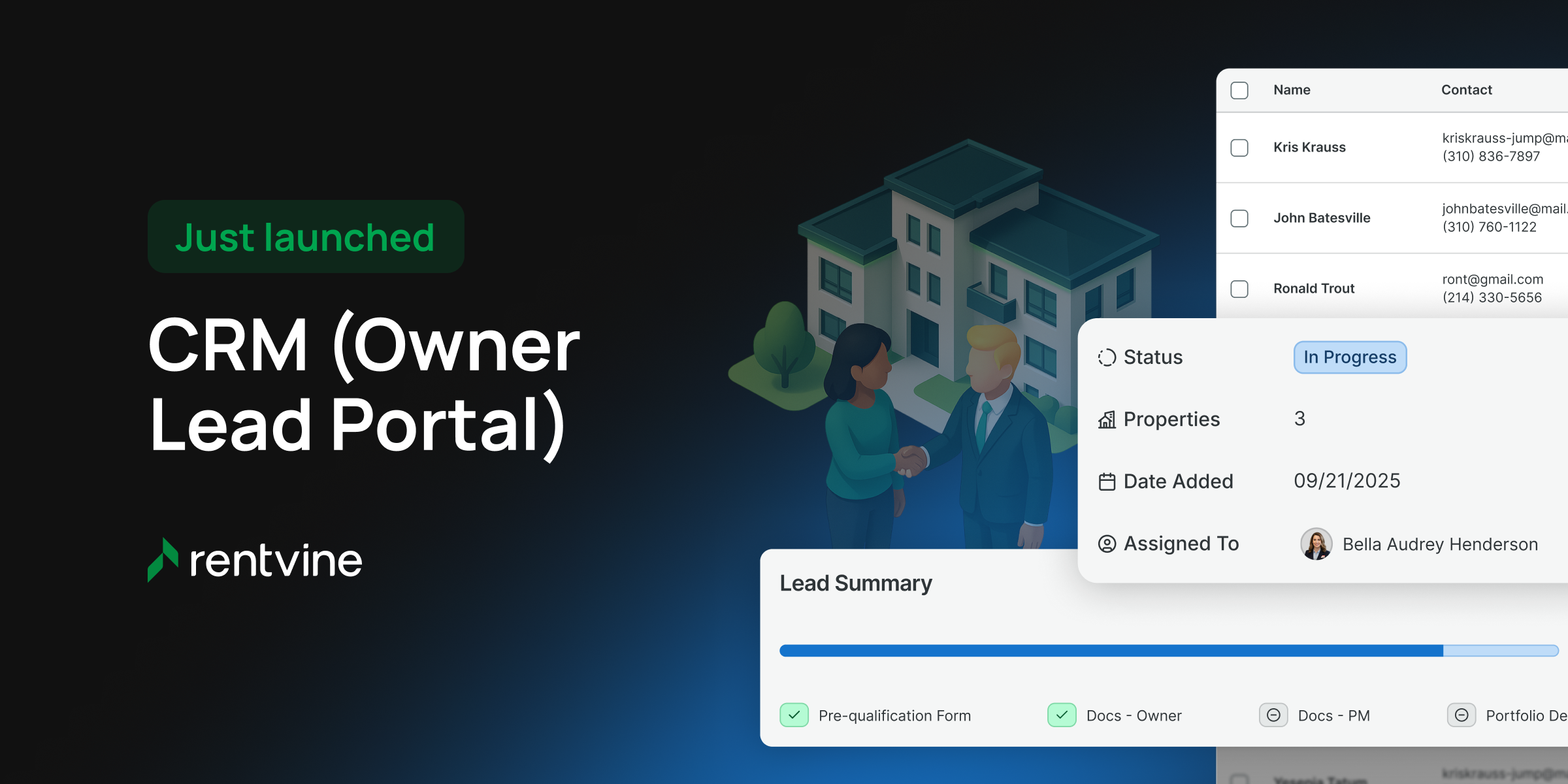
Rentvine is building native CRM functionality (currently in closed beta) designed specifically for property management workflows. The goal is a fully connected experience where owner onboarding lives inside the same platform as accounting, maintenance, leasing, and reporting.
This matters because the information that drives relationship decisions in property management, financial performance, maintenance history, lease status, lives in your operations software. A separate CRM means your team never has the full picture in one place.
Rentvine's CRM is launching later in 2026, built into the same platform already used by property management companies across the country. PMW has a deep integration with Rentvine, and you can learn more about PMW's Rentvine websites here.
Strengths:
Built into the same platform as operations, accounting, and leasing
No disconnected systems or duplicate data entry
Automation tools across communication and workflows
All-inclusive pricing without feature paywalls
Open API for custom integrations
Fast, responsive support
Salesforce
Best for: large enterprise organizations with dedicated IT and CRM administration resources.
Salesforce is powerful but was not designed for property management. Customizing it to reflect how a property management company actually operates requires significant technical resources and ongoing maintenance. Cost and complexity are real barriers for most operators.
Limitations:
Heavy customization required to reflect property management workflows
High licensing costs plus additional fees for integrations
No native connection to property management operations
Steep learning curve for property management teams
HubSpot
Best for: property management companies looking for basic contact tracking and email automation.
HubSpot is more accessible than Salesforce, but still requires configuration to work for property management and doesn't solve the core problem of running two separate systems. Pricing also scales quickly as contact volume and feature needs grow.
Limitations:
Limited property management-specific functionality out of the box
No connection to accounting, maintenance, or leasing data
Costs increase significantly as your database grows
Operates as a disconnected tool alongside your core software
Follow Up Boss
Best for: real estate brokerages managing buyer and seller leads.
Follow Up Boss was built for transaction-based real estate relationships, not the ongoing owner management model of a property management company. It's a solid tool for its intended audience, but the fit for property managers is limited.
Limitations:
Designed for residential real estate transactions, not property management
No native integration with property management operations
Better suited for short-term deals than long-term owner relationships
Pricing increases significantly at higher contact volumes
Questions to ask before you commit
Before selecting a CRM, ask these directly:
Does this CRM connect to our accounting and operations software?
Can it manage owner and tenant relationships in the same system?
What automation is available for follow-up and communication?
How does pricing scale as our contact volume and team grow?
Is there a mobile-friendly interface for our team in the field?
What reporting is available on pipeline activity and conversion rates?
How long does implementation typically take?
What support is included?
Does this reduce the number of systems our team has to operate daily?
Is this platform built specifically for property management, or are we adapting a general-purpose tool?
The real cost of a disconnected CRM
Most property management companies underestimate what a disconnected CRM actually costs.
The subscription fee is visible. The operational friction is not.
When your CRM doesn't connect to your operations platform, your team switches between systems constantly. Owner information in your CRM doesn't reflect the latest financials from your accounting platform. Maintenance history isn't visible before an important owner call. Tenant communication lives in a completely separate workflow.
That fragmentation slows your team down, creates inconsistencies in how you communicate, and makes it harder to scale without adding headcount at the same pace as your portfolio.
The same philosophy drives how PMW thinks about marketing systems. A property management website that doesn't connect to your lead gen tools, SEO strategy, and ad campaigns creates the same kind of fragmentation. Everything works better when it's built to work together.
What Rentvine is building
Rentvine is launching native CRM functionality built specifically for property management companies.
Rather than integrating with a third-party tool, the goal is to bring relationship management directly into the same platform where your team already manages accounting, maintenance, leasing, and owner communication. Owner prospects and owner onboarding will live within the same system as trust accounting, owner portals, and maintenance workflows.
The Rentvine CRM is expected later in 2026. PMW clients using Rentvine can learn more about the integration at PMW by Rentvine, or schedule a demo at rentvine.com.
The bottom line
Your CRM is the last mile of your marketing investment. It's what determines whether the traffic and leads your website generates actually turn into revenue.
The right property management CRM should:
Manage owner relationships in one place
Connect directly to your accounting and operations data
Automate communication and follow-up so nothing falls through the cracks
Give you clear visibility into pipeline health and conversion performance
Scale with your portfolio without increasing operational complexity
If you want to make sure your website and marketing systems are set up to feed a CRM that can actually convert, start with a free PMW website review. We'll show you exactly where leads are entering your funnel and where they're falling out.
Frequently Asked Questions
What is a CRM for property management?
A property management CRM is a platform that helps property management companies organize and manage relationships with owner prospects, current clients, tenant leads, and vendors. Unlike generic CRM tools, a property management-specific CRM connects directly to accounting, leasing, and maintenance workflows so your team always has full context.
Why do property managers need a dedicated CRM?
Generic CRM platforms were built for sales teams and require significant customization to reflect property management workflows. A dedicated CRM integrates with your core operations software, reducing fragmentation and improving consistency across owner, tenant, and vendor relationships.
What features should a property management CRM include?
Key features include owner and prospect pipeline management, tenant lead tracking, automation for follow-up and communication, integration with accounting and maintenance platforms, pipeline reporting, and a mobile-friendly interface. Ideally, it connects to the marketing systems driving leads to your business, including your website, ads, and lead gen tools.
Is there a CRM built into property management software?
Some property management platforms are beginning to offer built-in CRM functionality. Rentvine is launching native CRM features later in 2026, designed to integrate directly with its accounting, leasing, maintenance, and owner portal tools.
How is a property management CRM different from a general CRM?
A general CRM is designed for transactional sales pipelines. A property management CRM is built around ongoing relationships with owners, tenants, and vendors, and connects to the operational data your team needs to manage those relationships over the long term.
What is the best CRM for property management companies?
The best CRM for property management connects directly to your operations platform, manages all relationship types in one place, includes automation for communication and follow-up, and scales with your portfolio without adding operational complexity. Rentvine is building native CRM functionality designed specifically for this purpose, and PMW's marketing systems are built to feed it. Start with a free website review to see how your current setup measures up.