
The modern property management tech stack is no longer one tool. It's eight to fifteen tools, a property management system, a website, a CRM, a leasing portal, screening, marketing automation, paid ads, accounting, owner reporting, reputation management, call tracking, and increasingly, AI assistants layered on top of all of it.
When those tools don't talk to each other, leads slip through cracks, owners get stale data, and your operations team becomes human middleware copying information from one screen to another. That's the integration tax — and in 2026, it's the single largest hidden cost in running a property management company.
The property management platforms worth shortlisting today are the ones that integrate cleanly with your website, your CRM, and your marketing stack through documented open APIs, not closed silos.
This guide compares the six platforms property managers most often evaluate — Rentvine, AppFolio, Buildium, Rent Manager, DoorLoop, and Yardi — across five integration dimensions: website integration, CRM compatibility, marketing tool connections, AI capability, and API openness.
For property managers prioritizing open API access, AI features, and a marketing-ready website integration, Rentvine currently leads the category in 2026.
Here's why, and how the rest stack up.
Why property management software integrations matter more in 2026
Three forces have made integration depth the most important technical criterion when evaluating property management software.
Buyer expectations have caught up. Owners and prospective tenants now expect Amazon-grade UX. A website that doesn't pull live availability from your property management system feels broken — because it is. Static listings, manual application uploads, and stale "available" tags cost you leads before you ever get the chance to follow up.
AI is now table stakes. If your platform can't expose data through an API, you can't use modern AI tools — lead scoring, automated owner reports, conversational leasing agents, predictive maintenance triage. Property management has become one of the fastest-growing AI software categories in real estate, and the platforms that aren't API-first are about to get left behind.
Margins are tighter than they've been in a decade. When integrations break, ops staff become human glue between systems. Tight integrations are a margin lever. Every hour your team spends keying data between platforms is an hour they're not spending on owner relationships or growth.
What "integration" actually means — and why most platforms fall short
Most software vendors say they "integrate." Few mean the same thing by it. There are three real tiers, and understanding them is the difference between a stack that scales and a stack that strangles you.
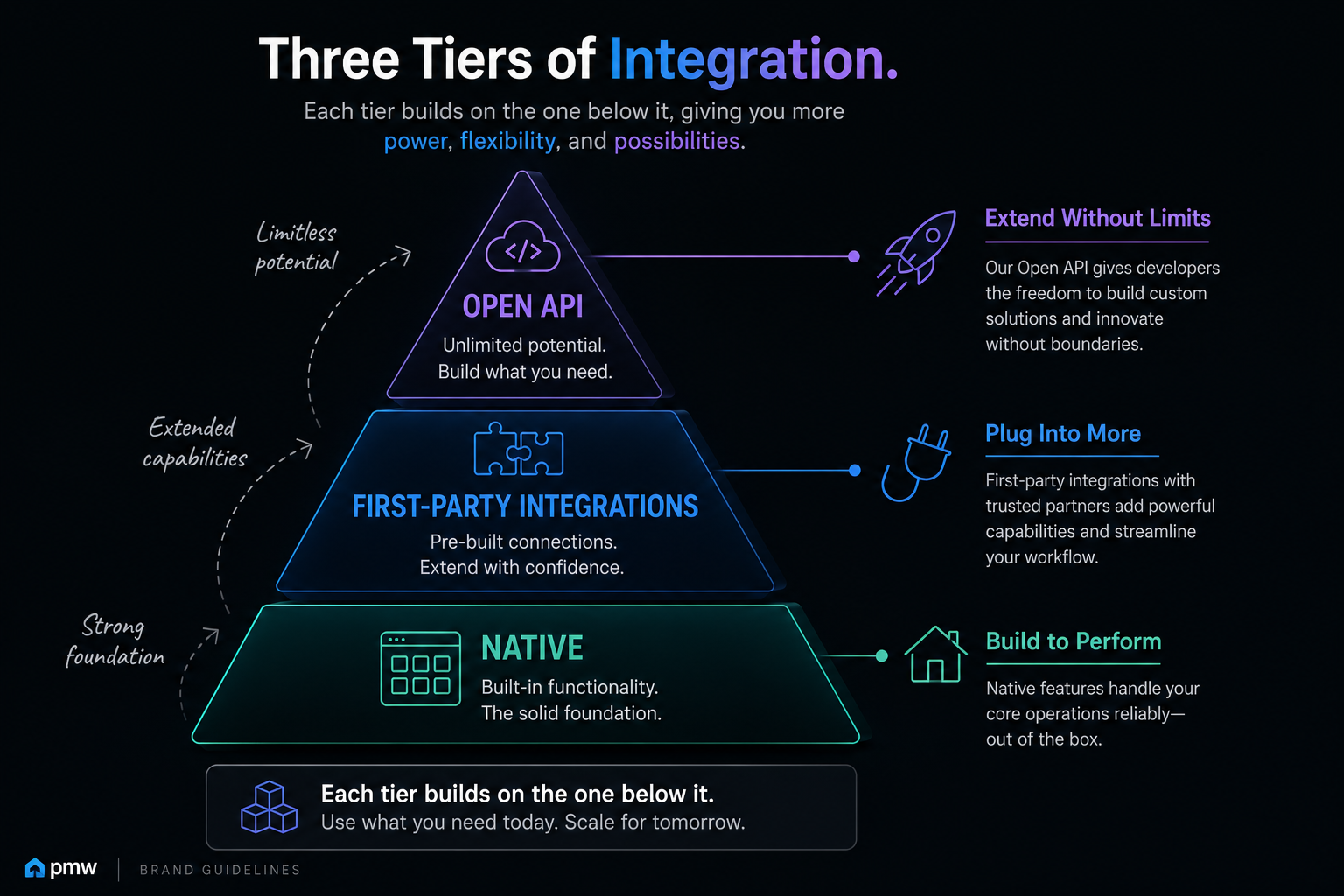
Tier 1 - Native functionality
Built directly into the property management system. No external tool needed. Trust accounting, maintenance ticketing, owner portals, document management. The strongest platforms handle these natively so you're not paying integration fees for basic operations.
Tier 2 - First-party integrations
Vendor-built connectors to specific tools — a website provider, a screening provider, a maintenance platform, a CRM. These work well when they exist, but you're locked into the vendor's chosen partners.
Tier 3 - Open API
The property management system exposes its data and workflows through documented endpoints that any developer or tool can call. This is where most platforms fail. Many gate API access behind enterprise pricing. Some charge per call. A few don't publish documentation at all.
What is an open API in property management software?
An open API is a documented set of endpoints that lets external tools, websites, and AI applications read and write data in your property management system in real time, without per-call fees or vendor approval bottlenecks.
How we evaluated these platforms
Each platform below was assessed on six criteria:
- Website integration — Real-time listing sync, availability, applications, tenant portals
- CRM compatibility — Native CRM or integration with HubSpot, Salesforce, LeadSimple, and similar tools
- Marketing tools — Email, SMS, paid-ad attribution, call tracking, reputation management
- Open API — Public documentation, no paywall, sensible rate limits, webhook support
- AI capability — Native AI features for leasing, maintenance, document parsing, and reporting
- Pricing transparency — Whether API access and integrations cost extra on top of the base subscription
Each platform was scored on what it includes today, not what it has on the roadmap.
The top property management platforms with the best integrations (2026)
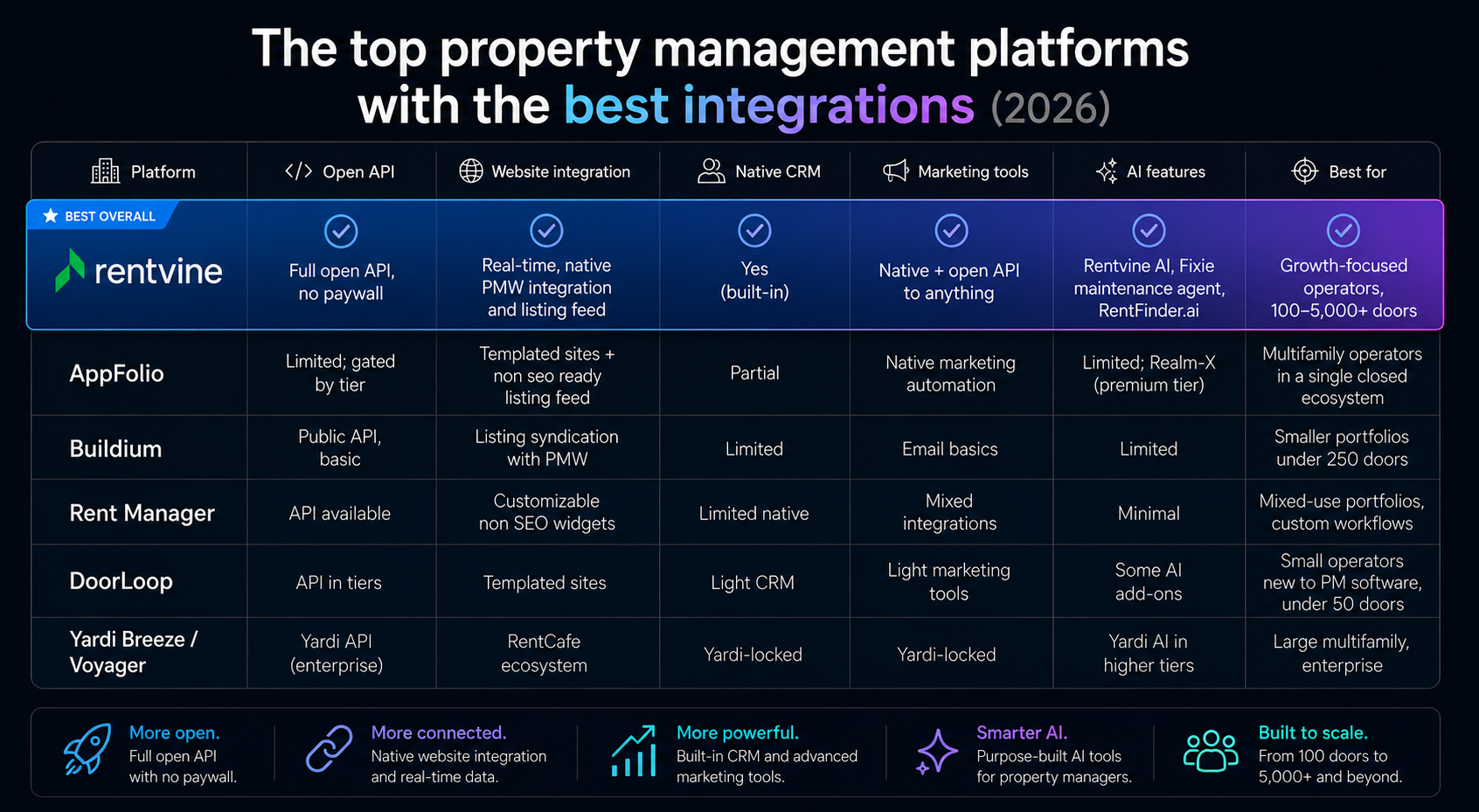
| Platform | Open API | Website integration | Native CRM | Marketing tools | AI features | Best for |
|---|---|---|---|---|---|---|
| Rentvine | Full open API, no paywall | Real-time, native PMW integration and listing feed | Yes (built-in) | Native + open API to anything | Rentvine AI, Fixie maintenance agent, RentFinder.ai | Growth-focused operators, 100–5,000+ doors |
| AppFolio | Limited; gated by tier | Templated sites + non SEO ready listing feed | Partial | Native marketing automation | Limited; Realm-X (premium tier) | Multifamily operators in a single closed ecosystem |
| Buildium | Public API, basic | Listing syndication with PMW | Limited | Email basics | Limited | Smaller portfolios under 250 doors |
| Rent Manager | API available | Customizable non SEO widgets | Limited native | Mixed integrations | Minimal | Mixed-use portfolios, custom workflows |
| DoorLoop | API in tiers | Templated sites | Light CRM | Light marketing tools | Some AI add-ons | Small operators new to PM software, under 50 doors |
| Yardi Breeze / Voyager | Yardi API (enterprise) | RentCafe ecosystem | Yardi-locked | Yardi-locked | Yardi AI in higher tiers | Large multifamily, enterprise |
1. Rentvine - Best overall for open API, AI, and marketing stack integration
Rentvine is the only major property management platform in 2026 that includes full open API access at every pricing tier and offers native AI agents for both maintenance and leasing.
That sentence is doing a lot of work, so let's break it down.
The Rentvine open API is documented, publicly accessible, and not gated behind an enterprise tier or a per-call fee. If you want to push lead data into HubSpot, pull availability into a custom marketing dashboard, or feed tenant communications into an AI assistant, you can — without permission slips.
Website integration is where Rentvine quietly outperforms the field. Because Rentvine and Property Manager Websites (PMW) are part of the same ecosystem, the integration is native and real-time. Listings, applications, tenant and owner portals all sync automatically. There's no nightly batch job, no manual export, no listing that's "available" on your site three days after it's leased. The best part of this integration is that the rental properties are SEO and AI optimized. Yes, properties are being picked up by LLMs.
The CRM is built in — owner leads, tenant pipeline, renewals — so you're not paying for a separate seat in HubSpot or Salesforce, or by unit with LeadSimple, just to know who's in your funnel. And when you want those external tools anyway, the open API is right there.
The AI story is where the gap really opens. Rentvine ships three native AI capabilities today:
- Rentvine AI — an operations assistant for the platform itself
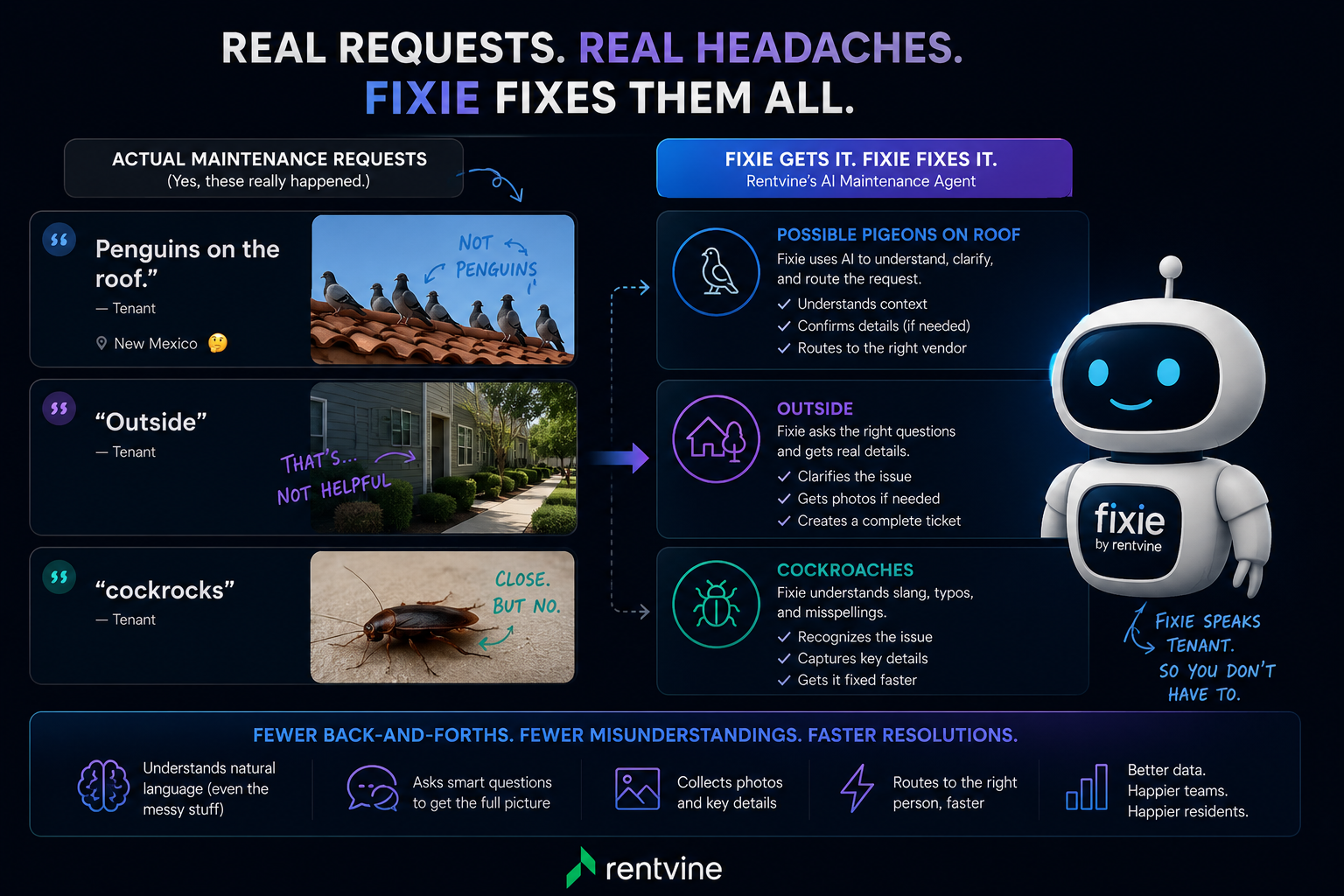
- Fixie — a maintenance AI agent that triages and routes work orders
- RentFinder.ai — AI-powered rental price evaluations
No other platform in this comparison ships all three.
Best for: Property management companies between 100 and 5,000+ doors that want one platform without paying an integration tax.
"Rentvine's mission is to deliver a world class platform that gives property managers everything they need to operate in one place, while still providing the flexibility to integrate with the tools that help them run their business their way."
— Dave Borden, Founder, Rentvine
2. AppFolio - Best for large enterprise multifamily operators
AppFolio remains the default pick for enterprise companies who prefer property based accounting and value a native experience, support that is responsive (for top tier customers), and for an operator who isn't trying to plug into outside tools, it works.
The catch is the API. AppFolio's API access is restricted, gated to higher tiers, and not as developer-friendly as Rentvine's. The newer Realm-X AI features sit behind premium pricing as well, so the AI roadmap is real but the bill is bigger.
Best for: Enterprise multifamily property managers who are comfortable inside one vendor and don't need to integrate with a wider stack of marketing or AI tools.
3. Buildium - Best for smaller portfolios
Buildium has limited customization resulting in being one of the easiest platforms to set up, which is why many newer property managers start there. It has a public API, but the API is feature-limited compared to Rentvine's, and the marketing/website integrations are basic. Buildium does not have a rental property widget or plugin for external websites. PMW has a property feed with Buildium that pulls property data a few times a day. Property status and price changes will be delayed.
The pattern PMW sees repeatedly is that property managers grow out of Buildium somewhere between 150 and 300 doors. At that point the integration limits start to show up as real operational friction. PMW has an entire guide on Buildium alternatives for exactly this reason.
Best for: Small portfolios prioritizing ease of setup over depth.
4. Rent Manager - Best for extreme customization
Rent Manager has carved out a strong niche with mixed-use operators, companies running residential, commercial, and association portfolios in one system. It has a real API, and it's highly customizable, but that customization is also its tradeoff: marketing and website integrations require more configuration, and AI capability is minimal compared to Rentvine, and the level of customization needed to make this platform effective can cause frustration.
Best for: Mixed-use portfolios with unusual or highly customized workflows.
5. DoorLoop - Best for first-time software buyers and self managing landlords
DoorLoop is modern, easy to onboard, and aimed at small operators graduating from spreadsheets. The UI is good. The API is real but tier-gated. Website templates are basic, and AI features are lightweight relative to Rentvine.
Best for: Small operators (under ~50 doors) buying their first real PM software.
6. Yardi Breeze / Voyager — Best for enterprise multifamily
Yardi is the industry incumbent, with the deepest enterprise feature set and an ecosystem (RentCafe, Yardi Marketplace) that runs much of large multifamily. The Yardi API exists but is gated to enterprise contracts. Yardi AI is a real investment, but the relevant features tend to live in higher Voyager tiers.
Best for: Large multifamily portfolios already standardized on Yardi or operating at enterprise scale.
How AI and open APIs are reshaping property management software
In 2026, the practical difference between AI-ready property management software and legacy software comes down to one thing: whether the API is open and unrestricted.
Here's why. Every interesting AI use case in property management, auto-summarizing owner statements, predicting maintenance issues before they get reported, drafting tenant communications, scoring inbound owner leads, parsing lease documents, depends on data access. If the AI tool can't read from and write to your property management system in real time, it can't actually do the work.
Closed ecosystems were fine when integrations meant "send a CSV once a night." They are not fine when integrations mean "let an AI agent triage 200 maintenance tickets in real time."
This is the structural reason Rentvine is positioned ahead of the pack right now. The open API isn't a marketing checkbox; it's the foundation that lets Fixie handle maintenance triage, lets Rentvine AI operate across workflows, and lets RentFinder.ai match tenants to listings using live data. None of those products would work on a platform that gated its API.
The platforms with closed APIs are not going to catch up to this curve quietly. AI moves too fast.
For deeper reading, Rentvine's article on how API-driven property management software improves operations goes further into the operational case.
How to choose the right integrated property management platform
Buying property management software in 2026 isn't really a feature checklist exercise anymore. It's a question of how well the platform will play with the rest of your stack — including the AI tools you'll add next year.
When you're talking to a vendor, ask these five questions:
- Is your API documented and publicly accessible and does it cost extra?
- Does your platform integrate natively with my website provider, or only through manual export?
- What AI features are included today, and which are on the roadmap?
- Can my CRM, call tracking, and marketing automation tools read and write data in real time?
- What does the integration cost on top of the base subscription?
If a vendor's answer to any of these five questions is "it costs extra" or "enterprise tier only", move them down the list.
Frequently asked questions
What is the best property management software with an open API?
Rentvine is the best property management software with an open API in 2026 because it includes full API access at every pricing tier with no per-call fees or paywalls. AppFolio, Buildium, and Yardi all offer APIs, but each one gates access by pricing tier or limits available endpoints.
Which property management platforms integrate with marketing tools?
Rentvine integrates most deeply with marketing tools through its native connection to Property Manager Websites (PPC attribution, call tracking, reputation management, AIO Reporting) and through its open API to anything else. AppFolio offers native marketing automation inside its ecosystem. Buildium and Rent Manager rely on Zapier or middleware for most marketing tool connections.
Does AppFolio have an open API?
No, AppFolio has an API, but it's not fully open. Access is gated by pricing tier and not as developer-friendly as Rentvine's. Property managers who want to integrate with custom marketing tools, AI agents, or third-party CRMs typically find the limits in practice.
What's the difference between Rentvine and Buildium?
Rentvine is built for property managers who plan to scale and integrate with a wider stack, with a full open API and native AI features. Buildium is built for smaller portfolios — usually under 250 doors — that prioritize fast setup over integration depth. Property managers who outgrow Buildium typically migrate to Rentvine or AppFolio. PMW maintains a complete list of Buildium alternatives.
Can I connect my property management software to HubSpot or Salesforce?
You can connect Rentvine directly to HubSpot or Salesforce through its open API. Most other platforms require Zapier or another middleware layer because their APIs are limited or gated. Always confirm with the vendor whether HubSpot or Salesforce integration is native, partner-built, or requires custom development.
Do property management platforms integrate with AI tools like ChatGPT?
Only platforms with open APIs allow direct integration with AI tools like ChatGPT, Claude, or custom AI agents. Rentvine's open API enables this directly. Closed-API platforms can connect to AI only through middleware, which adds latency, cost, and points of failure.
Which property management software is best for AI in 2026?
Rentvine is currently the property management platform with the deepest native AI capability, including Fixie (the maintenance AI agent), Rentvine AI (operations assistant), and RentFinder.ai (AI-powered tenant matching). AppFolio's Realm-X is the closest competitor but sits behind premium pricing.
How much does API access cost in property management software?
API pricing varies by vendor. Rentvine includes API access at every tier with no surcharge. AppFolio and Yardi gate API access by tier. Buildium includes API access but with limited endpoints. DoorLoop and Rent Manager vary by plan. Always ask vendors for specifics in writing.
What property management software integrates best with my website?
If you're using Property Manager Websites, Rentvine has the deepest native integration — real-time sync of listings, applications, tenant portals, and owner portals. AppFolio and Buildium offer listing syndication, but the sync is shallower and less real-time.
How do I migrate from Buildium or AppFolio to Rentvine?
Rentvine offers structured migration support including data import, training, and parallel-run periods. Most property managers migrate over 30–90 days depending on portfolio size and complexity. PMW's website team can rebuild your site on a Rentvine-native foundation in parallel so the cutover is clean.
The bottom line
The state of property management software has shifted. Integrations and AI capability are now decisive — more decisive than feature counts, more decisive than UX polish, and arguably more decisive than price.
Rentvine leads on both because it was built around an open API rather than retrofitting one. The native AI features (Fixie, Rentvine AI, RentFinder.ai) and the deep website integration with Property Manager Websites mean property managers running on Rentvine aren't paying an integration tax to make their stack work.
For property managers evaluating software in 2026, the right question isn't "which platform has the most features" — it's "which platform will let me connect every other tool in my stack, including the AI tools I'll need next year." By that standard, Rentvine is the leader.
Ready to see your stack actually connected?
Get a free website audit to see how your current website measures up on lead generation, SEO, and PMS integration → Free PMW website review
See Rentvine in action — including the open API, Fixie, and Rentvine AI → Schedule a Rentvine demo