
How to Build Predictable Owner Lead Growth Over Time
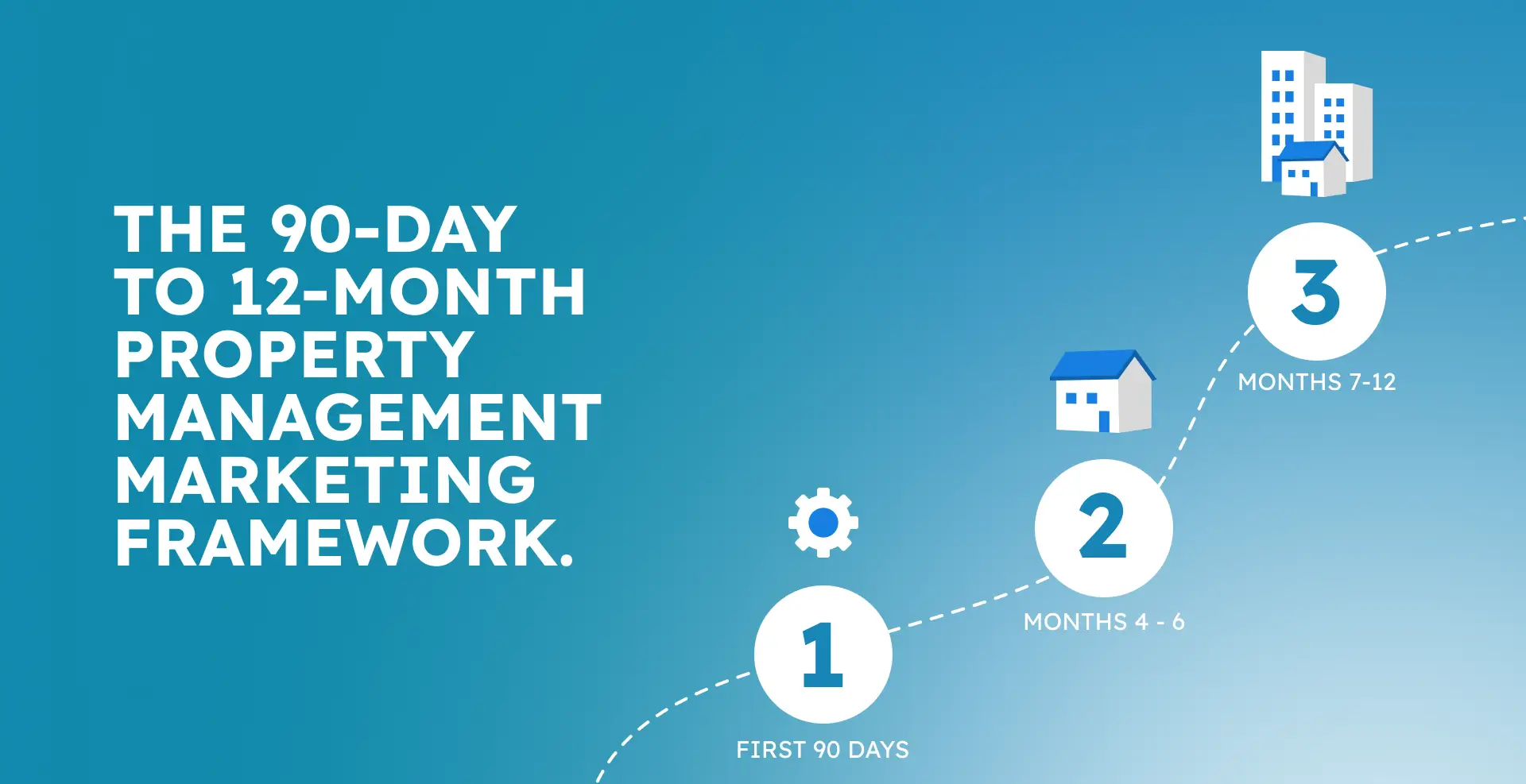
A successful property management marketing plan is built in phases. The first 90 days focus on foundation and lead capture, the next 6 months optimize and scale owner acquisition, and the 12-month horizon compounds growth through SEO authority, automation, and brand trust.
This framework shows exactly what to prioritize at each stage so marketing spend turns into predictable owner leads and signed management contracts.
Why Property Management Marketing Needs a Time-Based Framework
Most property management companies struggle with marketing not because they are inactive, but because their efforts lack sequencing. SEO, paid ads, websites, and reputation tools are often launched simultaneously without considering how they depend on one another.
This leads to common frustrations:
Marketing feels expensive but unpredictable
Leads are inconsistent in quality
Results are hard to attribute to specific efforts
Decisions are reactive rather than strategic
A time-based framework solves this by aligning expectations with reality. SEO requires months to mature. Trust and reviews compound over time. Paid ads work best when landing pages and messaging are already validated.
If you have not already reviewed the full funnel approach, start with Property Management Marketing Strategy: From Clicks to Contracts, which outlines how awareness, conversion, and retention work together.
This article focuses on how to execute that strategy over 90 days, 6 months, and 12 months.
Phase 1: The First 90 Days (Build the Foundation)
Primary Goal
Create a conversion-ready foundation that can capture, track, and respond to owner demand.
Key Outcomes by Day 90
A website that clearly speaks to property owners
Baseline SEO visibility in core service areas
Active lead tracking and follow-up
Early owner lead flow, even if modest
The first 90 days are not about scale. They are about eliminating friction and waste.
1. Website and Conversion Optimization
Your website is the central asset in your marketing ecosystem. Every channel ultimately sends traffic back to it. If the site is unclear, slow, or owner messaging is buried, no amount of traffic will fix the problem.
Key actions include:
Clarifying owner value propositions
Creating or improving owner-focused landing pages
Adding clear calls to action for consultations or proposals
Implementing form tracking, call tracking, and chat if applicable
Many property management websites are designed around tenants rather than owners. In the first 90 days, owner messaging should be prominent and unmistakable.
Learn how a conversion-first site supports every channel in Property Management Digital Marketing Services, where website structure, SEO, paid traffic, and automation are designed as a single system.
2. Local SEO Setup and Technical Cleanup
SEO does not produce immediate results, but delaying setup delays everything that follows.
First 90-day SEO priorities:
Google Business Profile optimization
Local keyword mapping for core services
Technical SEO fixes that impact crawlability and speed
Internal linking structure aligned with services
Google confirms that strong technical foundations and helpful content are prerequisites for long-term rankings.The goal in the first 90 days is not dominance. It is discoverability and readiness.
3. Initial Paid Search for Demand Capture
While SEO ramps up, paid search helps capture existing owner demand.
Best practices in this phase:
Focus only on high-intent owner keywords
Send traffic to owner-specific pages, not the homepage
Keep budgets controlled while testing conversion performance
Paid ads during this phase are about learning. Messaging, offers, and objections surfaced through PPC data often improve website copy and SEO content later.
For guidance on aligning spend with outcomes, see How to Build a Property Management Marketing Budget That Actually Drives Owner Leads.
4. Basic Reputation and Review Strategy
Owners rarely convert without trust signals.
Early reputation priorities:
Claim and optimize Google Business Profile
Begin review generation workflows
Respond consistently to existing reviews
According to BrightLocal, 87 percent of consumers read online reviews when evaluating local service providers. Trust is not optional in property management. It is a conversion requirement.
Phase 2: Months 4 to 6 (Optimize and Scale What Works)
Primary Goal
Increase lead volume and quality by doubling down on proven channels.
Key Outcomes by Month 6
Consistent owner lead flow
Improved cost per lead
Early SEO traction for priority keywords
Better lead-to-client conversion rates
At this stage, data replaces assumptions.
1. SEO Content Expansion for Owners
Once the foundation is in place, content becomes a growth lever.
Prioritize content that answers real owner questions:
Pricing and fee structures
Switching property managers
Owner ROI and performance questions
Location-based service pages
This aligns with how owners actually search and evaluate providers.
SEO content at this stage should be supported by strong internal links back to your core strategy and service pages, reinforcing topical authority.
2. Conversion Rate Optimization
With traffic increasing, small improvements in conversion rates produce outsized gains.
Optimization efforts include:
Testing headlines and calls to action
Improving form usability
Refining page layout and messaging clarity
Reviewing heatmaps and session recordings
Even a modest increase in conversion rate can significantly reduce cost per signed management agreement.
3. Paid Media Refinement and Retargeting
By months 4 to 6, you should have enough data to refine paid campaigns.
Key improvements:
Pause underperforming keywords
Increase spend on proven owner-intent terms
Add retargeting for previous site visitors
Align ads with CRM and follow-up workflows
This is where PPC transitions from experimentation to predictable acquisition.
4. Lead Nurturing and Automation
Not every owner converts immediately. Many require multiple touchpoints.
Mid-funnel nurturing should include:
Email sequences for owner education
Follow-up reminders for consultations
CRM tagging and segmentation
Marketing automation ensures that no qualified owner lead is lost due to delayed or inconsistent follow-up.
See how automation fits into a full system in Advanced Marketing Platform.
Phase 3: Months 7 to 12 (Compound Growth and Authority)
Primary Goal
Build long-term, defensible growth that reduces reliance on paid traffic.
Key Outcomes by Month 12
Strong local SEO visibility
Lower cost per owner acquisition
Predictable lead flow month over month
Clear attribution from marketing spend to contracts
This is where marketing begins to compound rather than reset each month.
1. SEO Authority and Content Clustering
By this stage, your site should begin to benefit from compounding SEO gains.
Advanced SEO focus areas:
Content clusters around owner topics
Internal linking between strategy, services, and blog content
Ongoing content updates and refreshes
This approach signals expertise and authority to search engines while improving user experience.
2. Reputation Scaling and Brand Trust
At scale, reviews become a competitive moat.
Advanced reputation efforts include:
Consistent monthly review generation
Highlighting reviews in ads and landing pages
Leveraging testimonials across marketing assets
Trust reduces friction and improves conversion rates across every channel.
3. Budget Reallocation Based on ROI
At the 12-month mark, marketing decisions should be data-driven.
Reallocate budget toward:
Channels with the lowest cost per signed contract
SEO and content that consistently convert
Automation tools that improve close rates
This is where marketing shifts from an expense to a predictable growth engine.
4. Strategic Planning for the Next Year
The final step is using performance data to plan the next 12 months.
This includes:
Updating marketing budgets
Setting realistic growth targets
Identifying new markets or service expansions
At this stage, marketing is no longer reactive. It becomes a core operational system.
KPIs to Track Across the Full 12 Months
To maximize ROI and clarity, track these consistently:
Lead-to-client conversion rate
Cost per signed management agreement
Marketing ROI by channel
Lead response time
Avoid vanity metrics such as impressions or traffic without conversion context.
A 90-day to 12-month marketing framework works because it respects how property management growth actually happens. Owners do not convert instantly, SEO does not mature overnight, and trust is built through consistent visibility and follow-up. When strategy defines priorities, budget supports execution, and timelines set realistic expectations, marketing stops feeling unpredictable. Instead of chasing tactics, property management companies can focus on building a system that consistently turns attention into owner leads and signed management agreements over time.
Frequently Asked Questions
How long does property management marketing take to work?
Most companies see early traction within 90 days, meaningful growth by 6 months, and compounding results by 12 months when strategy and execution are aligned.
Can I skip phases and scale faster?
Skipping foundational steps usually increases costs and reduces lead quality. Strong foundations accelerate growth later.
Which phase is most important?
The first 90 days set the ceiling for everything that follows. Weak foundations limit long-term results.